
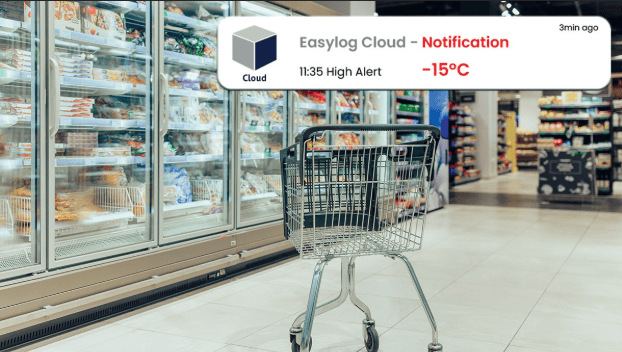
Supermarket freezers across Europe have been hacked twice in three weeks. If connected refrigeration controls can be compromised in supermarkets, it raises an important question for healthcare: what happens if the same thing happens to a vaccine fridge?
What happened in Europe
On 2 November, attackers took over refrigeration controls in stores across several European countries, pushing some units to 50°C overnight. It followed an attack on hundreds of French supermarkets on 12 October that spoiled food and caused significant disruption.
Similar connected controls can be found across refrigeration systems used in pharmacies, GP practices and hospitals. Here’s why that matters, and why independent temperature monitoring provides an important second line of defence.
Why vaccine fridges face the same risk
In both waves, the target was the networked control systems that run the refrigeration. In Belgium, technicians had to disconnect affected units from the network to regain control.
Many medical and pharmacy fridges now use similar connected controllers, remote dashboards or links to building management systems. These bring real benefits, but they also mean the fridge can be reached over a network.
French cybersecurity investigators blamed problems with outdated remote control modules made by Danish company Danfoss as well as U.S.-based Copeland. Danfoss said most affected systems were older products that no longer received software or security updates, while Copeland identified a vulnerability in discontinued controllers (AP). Healthcare settings that use connected refrigeration face the same type of risk.
This raises a question of trust. If a fridge’s controller is compromised, its display, alarms and logs may no longer be reliable. Where the system that cools the fridge is also the only system that records its temperature, a single point of failure can affect both.
The cost of getting it wrong
Cold chain failures already cost the NHS millions. UKHSA reported £6.4 million in vaccine wastage during 2025, based on published list prices, with cold chain failures accounting for 77% of the reported value.
For hospitals, GP practices and pharmacies, the consequences can extend beyond replacing stock: a temperature incident can mean quarantining vaccines, investigating their condition and postponing appointments while supplies are assessed or replaced.
If affected doses have already been administered, patients may need to be contacted and assessed for repeat vaccination. A cyberattack affecting several sites could multiply that disruption.
Independent vaccine temperature monitoring helps teams establish what happened, how long stock was exposed and make informed decisions about whether vaccines can still be used.
Why vaccine fridge temperature monitoring should be independent
The principle is simple: the system that controls the temperature should not be the only system checking it.
An independent vaccine fridge data logger has its own sensor and memory, providing a separate record of the temperature experienced by stored vaccines. If the fridge controller is compromised, faulty or switched off, the logger can continue recording what is actually happening.
For connected monitoring systems, remote alerts can also notify staff when temperatures move outside set limits, helping teams respond before an excursion causes unnecessary vaccine wastage.
How Lascar’s EasyLog monitoring supports vaccine storage
Lascar’s vaccine monitoring data loggers operate independently from the fridge controller, providing a separate temperature record alongside your refrigeration system.
Measures what the vaccine experiences. The probe sits in a glycol-filled bottle that responds to temperature like a vaccine vial, so brief door openings don’t cause false alarms.
- High accuracy and traceable calibration. Typical accuracy is ±0.1°C, with a traceable calibration certificate at 2°C and 8°C supplied.
- Alerts wherever you are. Set your own limits; if they are breached, the unit flashes and sounds an alarm, and EasyLog Cloud emails your team, day or night.
- No gaps in the record. The logger stores every reading even if Wi-Fi drops, then uploads it when the connection returns.
- Every site in one place. Monitor multiple fridges across multiple locations from a browser or app, with graphs, summaries and exportable records for audits.
- Less manual data handling. Continuous logging replaces handwritten twice-daily checks.
Because the monitoring system operates separately from the fridge controller, you retain an independent record of vaccine temperatures if the refrigeration controls fail or are compromised.
For pharmacies, GP practices, hospitals and other healthcare facilities, this provides a valuable second layer of temperature monitoring alongside the fridge itself.